Showing posts with label Benin. Show all posts

Sunday, 11 August 2013

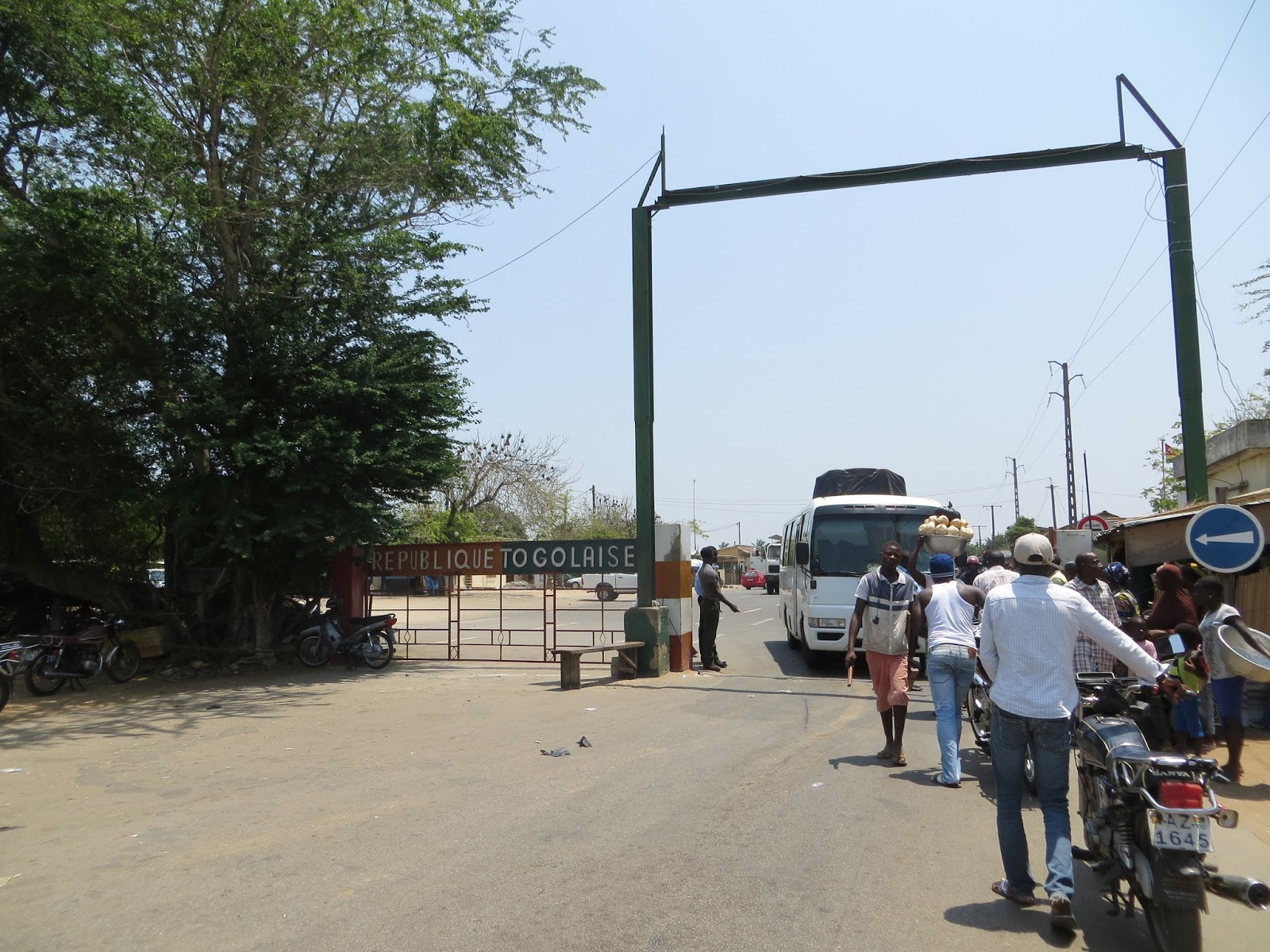
Viven : How we crossed from Benin to Togo


Dear Viven,

Sadly, Togo was an entirely transitory experience for us. We crossed the border from Grand Popo, Benin, in the early afternoon and went straight to the bus station in Lomé, Togo’s capital. Despite the hours of delay, our bus left for Abidjan in the early evening, and crossed into Ghana minutes after departure, which meant all we got to see of Togo was the beachfront by the station.


This crossing was originally intended as part of our route from Paris to Tanzania. Because of a visa issue with the DR Congo and then a car accident in Grand Bassam, our plans changed; this crossing instead formed part of the circular route we took from Abidjan, through Burkina Faso to Benin, and returning via Togo and Ghana.

Our previous crossing was from Burkina Faso to Benin, and in Lomé we got on a long-haul bus which took us into Ghana, and then from Ghana to the Ivory Coast. This letter is accurate as of the day we entered Togo, on Saturday 10 August 2013.


Visas
Visas are required to visit Togo, but not necessarily in advance. Seven-day visas are available at the border, but we acquired our 30-day visas in advance toavoid the potential trouble of opportunistic border guards, and time permitting, to allow for a longer visit.


We visited the Consulat de Togo in Abidjan, Ivory Coast, at 10:30am on 4 July 2013. The consulate, like those of Benin and Ghana, is located in the Deux Plateaux area outside the city centre, just off Rue des Jardins. We were sent inside to a man at a desk who was a little pissed off that we were interrupting his morning newspaper read. We waited while he finished with the sports section, and then supplied the required documents (passport photocopies, two photos each, hotel name), filled out the application forms, and were told to return that day at 2pm.


We returned at 2pm and the passports were ready, with 30-day single-entry visas.

Language
Togo’s official language is French, and as far as we could ascertain, it is widely spoken and commonly used. English holds the same rare status as in Benin and Burkina Faso.

Money
Togo is part of the West African monetary union, and uses the West African franc (CFA). We saw, but did not use, banks which accept Visa and Mastercard in Lomé.


The Route
After arriving in Natitingou in north Benin on 31 July we spent a few days exploring Pendjari National Park.  On 4 August we made our way by shared taxi to Cotonou (CFA 3,000 each, about eight hours), and after a few days in the country's de facto capital we visited the royal city of Abomey and the Voodoo-infused, former Dahomey slave port of Oudiah.

Our Means of Travel

We departed our hotel (the Auberge Diaspora), on the beach about 7km outside of Ouidah, at around 11am on 10 August. We caught a ride just a few minutes after walking with a Belgian-Beninois couple in a yellow truck, who took us all the way to Grand Popo, where we arrived at around 12:30pm. We waited at the ‘taxi rank’ (side of the road) for about ten minutes, until a shared taxi came to give us a lift to the border for CFA 400 each. We arrived at the Benin-Togo border at Hilla Condji at 1pm, changed over to another shared taxi which would take us straight to Lomé for CFA 2,000 each, left our bags in the car and walked through the border. The driver, anxious by how long we had to take to be processed (citizens of Pays de l’Entente and ECOWAS states, both of which include Benin and Togo, merely need to display their identity cards to move through). The taxi driver brought us straight to the STIF bus station, where we arrived at 3pm.

The Border

We arrived at the border at 1pm and waited in the Benin exit-stamp queue until 1:35. The border guard entered our details into a logbook by hand, and asked for the names of our hotels in both Benin and Togo. After receiving our stamps we were sent through the gate which marks the border, and spent five minutes with Togo officials to be logged in by hand once more, asked for the name of our hotel in Togo (we had one in mind, not expecting to catch the Abidjan bus the same day), and stamped to enter. We got in our shared taxi on the way to Lomé and were off by 1:45. The whole process from arrival to departure took 45 minutes. No bribes or cadeaux were requested, or even hinted at.

What We Needed
In Abidjan

  • Money: CFA 50,000 (25,000 each)
  • One photocopy of the first three pages of each passport
  • Two passport photos
  • Name of hotel in Togo
  • To fill out a straightforward one-page application form
  • Three and a half hours to process visas
For transport
  • Ride from Ouidah to Grand Popo: luck, 1.5 hours
  • Taxi from Grand Popo to Hilla Condji border: CFA 800 (400 each), 15 minutes
  • Taxi from Hilla Condji border to Lomé : CFA 4,000 (2,000 each), two hours
At the border
  • Passports with Benin and Togo visas
  • Names of hotels in Benin and Togo
  • 45 minutes

Whether because it’s the Pays de l’Entente customs-free zone of Africa, or because we’re no longer traveling in our own vehicle, borders have become a lot easier.

Happy trails,

QM

The border, entering Togo
Visa application form,
Togo embassy in Abidjan

Friday, 9 August 2013

o : Ouidah

Auberge Diaspora
Ouidah
Benin


Dear o,

It’s near midnight and the stars are out.  Al and I have had one of the best days of our whole trip.  The taxi – an actual vehicle, instead of the motorcycles which typically service Benin – pulls up in front of our empty hotel.  Al gets out the 2,000 francs, having resigned after we got in to the high price, and gives it to the driver.  He throws the money back at her, and says, “Dix mille”.  As it is the second time today we are told a different price at the end of the journey from the one at the beginning, Al is furious.  She leaves the money on the seat, and gets out.  The driver and I get out and I forestall him, as Alex crosses the road to our room (the hotel occupies both sides of the road).  He insists that that’s his price, and I tell him that CFA 10,000 is absurd for only seven kilometres – that we’ve crossed hundreds of kilometres over hours of atrocious driving for a third that rate, that we agreed to “deux mille” (an obvious and common misunderstanding).  As I’m trying to explain the possible misunderstanding, the driver pushes me.  I pivot around and get in his face, shouting hard and firm, “ne me touche pas!”.  He seems to get the message, and we’re somewhat calm again.

The driver makes a phone call to a “manager”, and screams and shouts.  He says the manager is on his way.  Al goes back and forth between the taxi and the hotel.  Three of the hotel guardians arrive, and I explain the situation.  They then hear it from the driver, in their own language, and in two seconds it is clear whose side they’re on.  The white tourist is trying to steal a rip-off price from the black taxi driver, of course.

“Fine,” I say, “we’ll wait for the manager.”

I pace back and forth on the dirt path leading from the gate into the hotel grounds, lit by the tall fluorescent light above.  The three staff walk to the other side of the road and talk with Al, who is still outraged, saying things like “ridiculous”, “absurd”, and “toujours, la meme chose.”

I hear quick, pounding footsteps behind me.  I turn and he’s there.  “Arretez,” I say.He pushes me again, and I push him back.  I put my hand out and say, “non”.  He slaps my hand.  I put my fists up.  He puts his up.

One of the staff has run back, but doesn’t get between us.  “Appelez la police,” I shout, without looking away from my opponent with the wild eyes.  But the hotel guardian doesn’t move.  “Appelez la police maintenant!”  The other two arrive, and do nothing.

My knees are bent, my feet are bouncing, my nails are digging into my palms.  The taxi driver throws a left punch.

***

It was a refreshing morning: finally, no work to be done.  No planning for the day, no arranging tomorrow’s early-morning bus.  No struggling to figure out what to do.  We had breakfast by the sea, a leisurely walk down the road, and a fascinating, though short, conversation with a Ogoni man on a bicycle.  He spoke of his people’s exile from Nigeria to neighbouring Benin, how there were only 52 left in the community, how they would be arrested, possibly killed, if they attempted to return, and of their website and committee work.  He rode on as we got motorcycle taxis into town, to the tourism office to find an English-speaking tour.

Against all odds, we found one, and it was just leaving: seven Nigerians packed into their two cars, ready to go, while we tested the guide’s English and confirmed that yes, indeed, he would be our guide (we’ve had a problem with this before).  Sure enough, we were on the first English-speaking tour of our entire trip, about to learn the ins and outs of Benin’s major slave trading port, and Africa’s voodoo capital: Ouidah.

First it was snakes, rendered harmless by their keepers and worshippers in the Temple of the Pythons.  We held them, played with them, and the Nigerians took dozens of photos of the girls running scared at the touch – and some of the boys, too.  A different guide accompanied us, and on his face were the six marks carved in with a knife when he was a few months old: two on the forehead, and two on each cheekbone, all up-down.

We moved on to the museum, which is inside a former Portuguese fort.  I have read about African slavery in many books.  I have helped to develop a play set on an 18th-century slave ship, where the captives perform in coffins of chalk.  I have visited other slave trading posts, met descendants of former slaves, and bemoaned the slavery which continues in our world today.  I have felt I understood it, appreciated it, defeated what remnants of it there are in my mind.

And then I stood in a room in a white-walled museum and looked upon an image of a slave ship with its rows of bodies, less living things, more like ticks of a pencil – accountings – while the Nigerians asked questions.  Would they jump into the ocean if they could?  Why would the owners treat them like that, if they were wanted for work?  One man, the most precocious one, corrected a sign in the museum that said the slave trade did not exist before the Europeans.  Yes it did, he said.  We kept each other as slaves before the Europeans came.  The Europeans just made it big-time.  There were no tears, no fury, no outward emotion; just the intense desire to learn and somehow, by learning, make right.

I couldn’t help it.  I was different in that room.  I am a white man.  No amount of reading will change my blood.  No amount of understanding will alter my heritage.  No amount of doing will erase what was done.  Nobody looked at me as such, but I did look at myself.  Where is it?  Where is the part of me that shackled men and women, beat them, ground them down, forced them to make me rich?  Where is the part of me that couldn’t stop the greed when it shipped millions from their home to grow me sugar, corn, cotton?  Where is the part of me that dug mass pits in which to throw the weak and diseased people, still alive, doomed to a last exhale on their own soil for not being strong enough for the voyage?  Where is that part of me, so I can fight it, wrestle it, kill it, and burn it?  Where is it?  I wanted to know so I could show the room in triumph, and learn of slavery as equals, as brothers and sisters.  But I couldn’t find it.

Following the museum we visited the Sacred Forest, admired the fantastical, whimsical and tellingly disjointed artwork made around the sacred giant tree, and tried the divine the stories behind the figures as well as the place, whenever the guide’s version was too plain.  The sculptures were either colourful or rustic, harsh or smooth, metallic or porcelain, and never in between.  The Sacred Forest is a place of impact, vitality and message, with contemplation ushered to the shadows.

We went for lunch and bonded with the Nigerians, whom we learned were out exclusively in Ouidah for the long weekend.  They told stories of how they got through the Benin border (a long, difficult and expensive ordeal, which we sympathised with), of politics, and of home.  One said that everyone in Lagos relates to Lagos life: you spend all day being busy, convinced of your busyness, consumed by your busyness – and yet at the end of the day, you’ve done nothing.  You drove from home to work, from work to home, recovering in between.  We talked about city living, city problems, and the bigger world.

After lunch we went along the Slave Walk.  We started in Ouidah’s centre (the old slave market, where slaves were purchased in exchange for goods), and stopped at the Tree of Forgetfulness, around which newly-chained slaves were forced to circle three times, in order to forget who they were, where they were from, everything.  Then the Tree of Return, again with a three-time circle, so that captives could return to Africa once dead overseas (though, still as slaves); and the common graves, where the unfit and the too-rebellious were tossed; and to the monuments at both of these sites.

Outside the garden of the Tree of Return, two of the Nigerians, Feyala and Begue, gave money to three kids who were begging.  The kid who received the coins walked away, and gave a pittance to his friends.  One of them cried, and they came to blows.  I watched it all unfold, leaning against the car.  They fought and screamed and cried, and I watched.  They saw me watching, stopped, came up to me, and asked for more.  I shook my head, absolutely not.  Then they just walked away and continued to fight.  On the other side of the car, the others were arguing about funding such sites like these in Nigeria, and one argued the money would be better spent on things people actually need, and he cited the kids who needed the money more than the art surrounding the slavery monument.  I didn’t say anything.

Finally, we arrived at the Point of No Return itself, a hundred meters or so from shore, with a grand new archway leading in and out, decorated, painted, beautiful.

Under the arch our guide tried to double our price for the tour, from 15,000 to 30,000.  Here we go again, I thought.  We prepared for another battle.  But the Nigerians got wind of it, and descended on the ring.  They had paid 25,000 francs for seven, while we were orignally stuck with 15,000 for two – let alone now, with 30,000.  Soon there was a bigger shouting match, and Al and I were silent.  In the end, we paid 6,000 more, and tagged along with our new friends / guardian angels to their hotel.

We played Marco Polo in the pool, ate a delicious dinner, and then spent a few hours over board games on the patio in front of their rooms.  We shared our war stories from the frontline of trans-African travel, and heard about their close, yet hilarious, calls with the Benin police.  All that, of course, under the booming weekend joy of some of the loudest, most gregarious, open-hearted people I’ve met in a long time.  Needless to say, Al and I had a blast.

Akimbo, whose birthday it was, called us a taxi.  Not long before midnight it arrived.  We said goodbye, collected a few contact cards, and walked out with an escort.  We asked the taxi driver how much.  We heard “deux mille”, agreed, and drove off.

***

I dodge the taxi driver’s punch.  It’s easy; he’s slow, maybe drunk, and too furious to calculate.  I’m going to hit back.  Everything in me wants to drive him into the ground.  I wait for the next one, for him to open himself.

He charges forward, and stops.  There is a gap, and one of the hotel guardians steps in between us.  I don’t put down my guard.  “Appelez la police,” I say again.  One of the others shakes his head, in part begging me not to, in part telling me, that won’t happen.

Al is across the road.  “Call the police,” I yell.  “How?” she asks.  “Find a way.”

There is no way.  No cars on the road, no telephone, no other guests.  “Should I go down the road and find someone?”  I look at the taxi driver.  He’s angry, but surrounded.  I realise my fists are back down.  “No,” I say, “just wait.”

A few minutes later the manager of the Casa del Papa arrives.  He explains that 10,000 is the price he agreed to pay when he called for the taxi.  Nobody told us that, I say.  He apologises.  And it’s still far too expensive.  He apologises.  I tell the manager to get the taxi driver to get our 2,000 out of the car.  The driver does, and passes the money to the manager, who passes it to me.  I give the manager 10,000, who passes it to the driver, who is unsatisfied.

“Je ne suis pas une voleur,” I declare.  I am not a thief.

I walk away.  I try to think of how everything that just happened relates to everything that happened before.  I can’t quite figure it out.  It’s a simple story, really, and I hope I tell it for some other reason than to give you some suspense.  There is a misunderstanding over the price, and it comes to little blows on the way to bigger ones.  In the end, everything is sorted, everyone goes home (or to their room), and the police are never called.

Whatever, right?  Who cares.

Forgive me.  I do.  I’m still searching for that part of myself, that chained my brothers and sisters, reduced their humanity, and eradicated their history.  The Africans, too, feel the same guilt and share the same past.  They did indeed capture and keep and trade each other as slaves before the Portuguese and the British and the French commandeered the enterprise and globalised the market.  So here I am, and all I can think about are those kids, who fought with fists and tears over coins outside the walls of a monument to slavery.  And I think –whoever I am to think it –it’s not over.  It’s still in me.  It’s still in all of us.  We’ve got a lot of work to do.

Yours,

QM


The Python Temple
The one-footed warrior
in the Sacred Voodoo Forest
Spirit statue,
Sacred Voodoo Forest
Slavery Monument
near the Tree of Forgetfulness
Slavery Monument,
on the site of the mass common slave graves
The Point of No Return,
on the beach

Thursday, 8 August 2013

Mr. Gobrick : Labourer, Craftsman, Artist

Dear Mr. Gobrick,

He who works with his hands is a labourer.  He who works with his hands and his head is a craftsman.  He who works with his hands and his head and his heart is an artist.
          - Francis of Assisi

So this is how I take up your invitation to write you about art – with a quote you certainly know, from a thinker you probably disagree with, followed by opinions you will likely reject.  And all that, along the lines of a subject you just might detest: defining art and the artist.

I’m in the palatial city of Abomey, the seat of the old Dahomey kings in south-central Benin.  My girlfriend and I are traveling across Africa, en route from Paris to Tanzania, where we will live for a year.  Our schedule, along with unforeseen events, has limited the countries we have time to truly dig into to just three: Morocco, the Ivory Coast, and now Benin.  Of the three, little Benin has been the most surprising. 

I mention where I am because it was a single day here in Abomey that made Assisi’s quote make sense, that dipped the theory into reality, and that gave me another excuse to try to be clever.

The indigenous African kingdom of Dahomey had its capital here from its inception in 1625 to its end in 1894, when the last real king (as in, not appointed by the colonising French)Béhanzin burned down the royal palaces here as he fled north in defeat.  The kings, who acquired their great power and wealth by conquest and by selling slaves to European traders (as many as 20% of all slaves taken from Africa during the centuries-long trade were bought from Dahomey kings or their subjects), each built a personal royal palace here on the Abomey plateau.  Only Béhanzin’s (pronounced somewhat like Béyonce) personal palace remains intact, and his relatively large complex is the site of the museum, the heart of today’s tourist circuit, and the location of Abomey’s much-treasured, oft-mentioned UNESCO World Heritage plaque.  The other palaces which dot the city of 90,000 people have all been rebuilt, and while mostly empty, as a far-flung collection they give a hint of how grand and expansive this city once was.

Abomey is one of Benin’s premier tourist destinations, and this reputation is a twin result of the palaces and the city’s arts and crafts, and much of the latter borrow the style of the older work found in the museum.  Our arrival by motorcycle taxi (Zem) was accompanied by the usual shouts and taunts of sellers along the road, but little did we know, one artisan-merchant followed us into our hotel.  He was the Labourer.

He sat on a chair nearby to where we took our lunch, and eventually said hello.  Most hotels don’t allow merchants into their grounds, so we figured he was a guest or had business there.  He chatted to us about where we were from, and mentioned that he had a shop in town, and made crafts.  Would we like to see it?  Sure, why not, we said, after lunch.  And then, a few seconds later, we saw he had brought his wares with him, and they were plopped down on our table.  It was clear that this guy wasn’t just hanging out, making conversation.  And forget lunch – we have to spend money!

Whether I’m in rural paradise or birdhouse suburbia, I usually shy away from stuff on sale.  If I need a shirt, I buy a shirt.  If I have to get a gift, I get an idea for what I want, and search for it.  But I’m no window-shopper, and the best way to guarantee my inattention is to tell me you want to sell me something I wasn’t looking for in the first place.  With the Labourer, however, I made an exception – maybe he’d be the diamond in the rough, worth the chat and the analysis of art?

The man made woven cloth pictures: a rainbow lion, a bunch of fish, a few people standing in a circle, all arranged in squares.  The pieces of fabric weren’t large enough to make blankets or quilts, and so had no practical purpose other than to hang on a wall or raise like a flag.  Now, I have no desire to insult or degrade, but the Labourer’s work was derivative, false, cheaply done and impatiently made.  There was a mass-produced formula you could see in the stitching before he even unfolded the pieces.  There was no inspiration, no message, no thought or feeling in the work.  The man worked with only his hands, riding only on the desire to make money fast.  He was the quintessential labourer, reproducing the same thing over and over again, hoping for profit in quickness and better returns on low quality.

I have no qualm with the Labourer.  I value him higher than the importer of plastic sacks of mass-produced, foreign-made garbage.  I commend his hard work and his ability to do something I couldn’t.  But he’s after money and money alone, and this shows up in every stitch and every weave – except, maybe, for that fun he had with the technicolour lion king.  For Assisi, his place is set.

Though it was clear that the Labourer’s work was derivative, I didn’t know until the next day just what it was derivative of.  The same arrangement in squares, the same style of drawing animals and people, was evident on the front of every single royal palace, and with most of the artifacts in the museum.  There are hundreds of symbols the Fon people used to decorate their kings’ palaces: fish, bowls, men, fruit, weapons, trees, tools, lions, elephants, birds, you name it.  Each building’s front is furnished with bas-reliefs of these symbols, with each symbol placed within a sqaure cut into the wall.  At the rebuilt palaces, the squares are a clear white, and the symbols are vibrant and clear; the original palaces, meanwhile, feature original artwork: faded, damaged, but robust and of the same ilk.  In the museum, there are quiltworks and wooden artifacts which feature the same style but in concentrated, intricate forms.  All of it reminded me of the art of ancient Egypt: crafted expertly by a certain tried and tested formula, emphasising the principal features of the subject at expense of realism (so, an Abomey lion’s legs and feet at profile are the same size, just as Egyptian figures in profile have elongated feet, huge eyes, and full torsos), and detailed not just as artwork but as a means of communication, a language.  For these symbols – just as the Egyptian hieroglyphics – tell a story, tell a history. 

For me, these carvers from centuries ago were Craftsmen.  They worked with their hands, of course, but they followed the rules and laws of their art as governed by the kings, by tradition, and by religion (Voudun, or Voodoo).  Just as with most medieval European religious art, the need of the patron and the need of the thing being expressed far outweight the desire, passion and raw power of the individual artist; indeed, as you know, individualism in art (where an artist signs his work) is a relatively recent phenomenon, and obviously didn’t sweep up the Dahomey monarchy.  There is a lot of head as well as hands in these works, but like the hieroglyphs of Giza or Luxor, I can’t find a lot of heart. 

We were on a guided tour of Abomey, which took us through the royal palaces and ended up at the museum.  As expected, the guide’s penultimate stop before the museum was a visit to the arts and crafts sector of Abomey.  We didn’t say anything, but Al and I looked at each other, knowing we’d be in for another “buy this, buy this” trip.  We passed through a few huts where men and women worked on foot-operated weaving machines.  They were Labourers, caught up less with the colours and shapes of their products than with the wooden blocks and constant rhythm which, even for me, was a little hypnotic.  I didn’t want the scarves they made, but I would certainly walk away with a machine if I could.

After the machines and their operators, we wound through another palace and into another part of town.  From a distance I could see masks and paintings on the walls, and thought we would now be heading into the hustler quarter.  But when we arrived, just one shirtless man greeted us.  He had a wide, shy smile and was covered in paint.  He didn’t hold necklaces and bracelets in his hands, didn’t call me “my friend” or “mon frere”, and didn’t block my way out.  He just opened the door to his shop, and watched me watch his stuff.

The man’s name is Adjamalé, and he is an Artist.

Adjamalé signs his work with name and date, and I couldn’t find a painting older than 2011.  He has dozens of canvases on which is watercolour, oil and other objects such as pebbles, coins, bills, paper, and a pair of jeans.  He is also a sculptor, with virtually every piece containing a person, who variably rides a bike, scales a wall, picks up flowers or sits on a throne looking scary.  Adjamalé is the classic artist who immerses himself in his work without inhibiting thought or self-consciousness, who could very well spend weeks in his shop, tweaking and pasting and painting and imagining.  He is physically  overwhelmed by his own creativity, stepping over the mountains of Art which, to him, fit like brothers with the stones on the ground.

But, to me, what makes Adjamalé an “Artist” is not his habits or his discipline; it is the work itself.  Adjamalé is trying to say something with his work, he’s trying to express something that cannot be expressed in any other way.  His expression is profoundly personal and yet (as it is art) public, thought-out yet spontaneous, funny yet significant, substantial yet childlike.  His sculptures and paintings both exhibit the trait of the masters: they walk the tightrope between greatness and a joke.  They ask, if you are drawn in, why are you drawn in?  And they captivate the observer by happening to be (rather than forcing themselves as) windows into the inner life of their creator.

In much of Adjamalé’s work, we find ourselves in a dreamscape.  City towers double as tall, reaching people, and in their shadows walk the tiny figures of light.  A face encapsulates a forest, and warps into the sky.  It’s hard to do this well without looking like you are just ripping off the Surrealists, but Adjamalé is original and shrewd – he’s also free of the traditions which hamstring so much mainstream (meta-)art.  When I asked him if he knew of Salvador Dalí, he shook his head.  Same with Picasso.  But when I mentioned dreaming – “rêve” – his face lit up, and he took me to another room.

I didn’t buy anything from Adjamalé, and I’d be lying if I said that’s not what he wants.  He is trying to make a living too, but if he had all the money in the world, he’s still draw, he’d still sculpt, and he’d still be covered in paint.  He is not defined by his tools or by his customers, but instead defines them.  He works with his hands, with his head, and with his heart.

So what is art, then?  Can only an Artist make Art?  Why not a Craftsman, or a Labourer?  If I bought the merchant’s rainbow lion, buried it in a time capsule a hundred metres into a mountain, and it is recovered in ten thousand years as one of the few pieces of human heritage left from this era, what would the extraterrestrials say of it?  Even if they are blessed to be able to compare it to Picasso or Damien Hirst (who does not, by the way, work with his hands), wouldn’t they call it art as well?  Is it all in the eyes of the beholder?

Some of Adjamalé’s paintings contain letters that look like Chinese characters, but are clearly something else.  When I asked him what they were, he said they were his own language.  When I asked what they said, he simply stated that they told his story.  His eyes told me that he would elaborate no more on the strange, ordered, blocked-out lines.

Maybe the code by which art and the artist are defined is also written in such characters, interpretable by the artist alone, or perhaps by nobody at all.  Or maybe that last sentence is just a cheap segue for me to conclude my letter and try to be clever at the same time.  How safe is it to say, I don’t know? 

Whatever the case, if you find yourself in Abomey, visit Adjamalé.  He’s worth it.

Yours labouriously,


QM

PS: I've attached some photos, so you may now judge my poor taste.

One of Abomey's mesmerising labourers
One of the rebuilt royal palaces of Abomey;
notice the crafts that ornament the entrance
The royal palace of Guezo, Abomey
By Adjamalé
By Adjamalé
By Adjamalé
Adjamalé's gallery
Adjamalé


Monday, 5 August 2013

o : Ganvié

A pirogue near Ganvié
Lake Nokoué
Benin


Dear o,

For the first time in Africa I wish I were a child growing up here.  I imagine getting up in the middle of the night, sneaking past my parents and brothers and sisters.  I crawl down through the secret trapdoor next to the black rubber-covered shower stall, drop into the dark water, and swim between the stilts to my friend across the canal, who waits at the usual spot with the red face painted onto the bamboo.  In his older brother’s dugout canoe we got out to catch fish jumping from the farmed reeds into the moonlight.

This is Ganvié, the town on stilts.  It was built several kilometres out on the lake by the Tofinu people in the 1600s, to avoid the Dahomey slave traders who were prohibited by belief from going onto the water.  The town – as well as its people, their customs, their livelihoods, and to some extent their isolation – has lasted the centuries.  Most of the bamboo houses and shops we pass by are relatively new.  I can’t imagine the oldest constructed part of Ganvié is older than a century, solely because of the longevity of wood sunk in water.  But in the centre of the floating city is an artificial raised-earth section with a large, well-kept mosque, sturdy houses and businesses, and plenty of farming.  Beyond this human-made island are a few other goat-pens and gardens, secured from the water by a wood floor and a layer of soil.  The canals are busy with market traders, food-sellers, cargo holds, and fishermen (mostly boys, some as young as six with a dugout boat and cast net of their own).  The rows and rows of houses are connected by catwalks, ropes, thin beams and, of course, secret passageways.  A woman was just sharing a joke with her two friends on a ‘porch’ (dock) with their feet in the water, their laughter carried by the water throughout this echoing, labyrinthine civilisation.  I’ve heard that in Mongolia a child learns to ride a horse before learning to walk.  I wouldn’t be surprised if the girls and boys here take their first steps between the gunwales of a pirogue, with a paddle in hand.

I’ve been to Venice, and I don’t think anyone else who has could visit Ganvié without making the comparison.   People get around by boat.  Stuff is carried by boat.  Tourists come to ride in a boat.  But the travel-and-compare game is quickly ineffective in Ganvié, and it becomes a bore  not long after one moves from the idea of a place to the place itself.  Venice is made of stone, marble, brick and tiles.  It is cobbled, signposted and totally accessible on foot (once you’re on the island).  There are statues, monuments, chapels, cathedrals, museums, palaces, city squares, gardens, towers and tourist information centres, not to mention all the hotels, restaurants, shops, galleries and – yes – actual homes.  Venice is huge, cosmopolitan, modern (behind the Renaissance mask), and far older than Ganvié.

Perhaps, hundreds of years ago, Venice was not unlike Ganvié; at some point it must have been an unassuming collection of people out on the water trying to make a livelihood and a life.  But today, the ethos of Venice is totally different: it is all about permanence.  The people of Venice, or more accurately the people who want to preserve Venice, are unconcerned with crops and families, goats and traditions.  They are fighting a war with the sea, a struggle that goes back centuries to hold back the tides and the storms and natural cycles of our world.  21st-century climate change threatens Venice all the more, but the Doges as well as the historical preservation societies have all known what it means for the oceans to rise.  And this is what makes Venice so fascinating: it is not just an island battling the swamp.  It is all humanity battling time.  It is our desperate desire, in our own lives and in the lifetimes of our civilisations, to make a mark, be remembered, and with any measure of impossible luck, last forever.  In Venice, as elsewhere, we lace our roots with steel and emboss our branches with gold.  The tree’s future will grow longer, yes, but it cannot be immortal.  Though we’ll try, by the gods, we’ll try.

There is no such arrogance in Ganvié.  Maybe in every boy or girl is the dream to be different, be special, and live on through the millenia; but nobody here acts like it.  Nobody builds like it.  Nobody talks like it.  When in the middle of the night I cup and kick the water, silent as a fish, on the way to my friend’s brother’s canoe, I’ll think of it as the most significant thing that’s ever been done.  Our jokes will be the funniest ever told, our laughs the hardest on the belly there ever was, and the moonlight monster who almost ate half our canoe (see the tooth marks?) the biggest, meanest, most aggressive creature the world has ever seen.  Ganvié won’t be a 16th-century world, an older world, a tourists’ world, an expensive world, or even my parents’ world – it will be mine, made by my hands and feet and eyes in every moment I live.  And there are treasures underneath the stilt houses; the very fact that they are buried makes them treasure.  I won’t worship the wood on which I sleep.  If I ever do sleep.

The unspoken irony of my letter is not lost on me.  For a healthy, well-traveled, privileged westerner to say he wished he could have grown up an African, in an African village, on a foundation of precarious African bamboo.  Not only that, but a westerner with an interest verging on belief in architecture, history and, well, permanence.  Because the same boy I wish I could be would probably trade wishes with me, does this make me ignorant for the dream?

Africa has the fastest-growing population on earth, as the twin result of improving birth rates and longer lives – but infant mortality is still abhorrently high, and most lives are still tragically short.  A typical boy who grows up in Ganvié can expect to do what he learned to do long before puberty: fish.  He can hope to avoid or at least survive disease which to this day plagues his continent: malaria, AIDS, sleeping sickness, yellow fever, typhoid, hepatitis, even polio.  He can aim to keep his health, to feed himself and his family, find and feed a good wife, raise and feed good children, and earn the respect of his community.  If education, or politics, or travel – or archicture, history and permanence – enter into his sphere of desires, then these will not so much change him into an educated, politically-minded traveler with an interest in history, but rather more likely into the town dreamer.  The absent-minded fisherman.  The quiet one who always wanted to learn to read properly, and the one who as a boy knew more words for the pale foreigners than merely, ‘donnez-moi l’argent’.  If the boy skips town, he’ll likely end up in the big city of Cotonou, making bricks, selling peanuts, or if he’s lucky and smart, driving a taxi.  In much of Africa, Ganvié  being no different, who you are is who you were born to be.  Do I still wish to swim in the reeds and splash from below my older sister in her sleep?

Yes.  That’s the gift of imagination.  I don’t have to turn back time to live a little in Ganvié and Venice.  It’s something we all have.  I can see it in the eyes of the little boy in his canoe, who sits and looks at me between the stilts, floating beside the red face painted into the bamboo.

Yours,


QM

Ganvié 
Ganvié 
Ganvié mosque
Ganvié 
Ganvié 
Ganvié market 
Ganvié boy fisherman
Ganvié

Saturday, 3 August 2013

Viven : How we would have crossed from Benin to Nigeria


Dear Viven,

Because of our changed route and then the car accident, this is one border crossing we prepared for (it was quite the preparation, if only for the visa) but never got the chance to do.  

Visas
Visas are required in advance.  We visited the Nigeria embassy in downtown Abidjan, Ivory Coast, on Tuesday 2 July.  The embassy is centrally located (near the French embassy) and easy to find, at the following address:

Immeuble Maison du Nigéria
35 Boulevard de la République
01 BP 1906
Abidjan 01

Unlike most secrecy-loving, assistance-hating embassies in Africa, there are several signs at the entrance displaying helpful information, including that visa applications are only to be made from 9am to 12:30pm, Tuesdays and Thursdays.

The Nigerian embassy is a fortified, green-gated and barbed-wire enclosed military compound / office tower.  Two heavy steel doors, only one of which will open at a time, grant access to a holding area beside an air-conditioned kiosk, where one's business is stated and from whence is asked the first barrage of questions.  We arrived here at 9:45am, asked to apply for a tourist visa, filled out the 3-page application forms, and furnished all the documentation one could possibly want: vehicle registration, vehicle insurance, carnet de passages, passports with a mind to our other visas (we already had Ghana and Benin), letters, reservations, one of our Michelin maps, everything.  The application form was equally thorough, asking for previous countries visited, previous countries lived in, names of fathers and mothers, past drug use, and so forth.  We were told we needed letters of authorisation from our countries of nationality, but we argued that our countries didn't issue these as we were assumed to free to travel.  Our embassies, when contacted, were either too busy or respond, or didn't know what we were talking about.  Our argument, and Al's letter of employment in Tanzania, sufficed.  We were, however, asked to furnish a map of our overall African route, so I found a nearby cybercafe (there are plenty on Boulevard de la République) to do some Google Mapping and printing.

Up the steps from the holding area is a sparsely-decorated but air-conditioned waiting room.  After I returned and handed over the crisp new route map we sat outside in the hot sun, to the astonishment and dismay of the African visitors and staff, and waited until 11:30am to pay.  A helpful and friendly beige-shirted man told us the rates, and when we asked why the British rate was twice that of the Canadian, he laughed and said, "because you are our former colonial masters".  We paid at the holding area kiosk, got our receipt, were told to return at 10:30am the next day for an interview, and just before leaving were waved down by the beige-shirted man who said he could get us an interview that day.  We waited until 12:30pm, and visited a kiosk attached to the waiting room.

The interview took 15 minutes.  We were asked many more questions: why Nigeria, where in Nigeria, how long in Nigeria, why are we going at all, when did we leave, where did we leave from, why are we going by vehicle, etc.  Seeing no problems, we were dismissed and told to return the next day at 3pm to receive our passports with visas.  We returned at the set time, waited 15 minutes, and received our passports with 8-day  single-entry transit visas.

Insurance and Carnet
If we crossed with the truck, our carnet de passages would have been necessary as usual.  As well, we would have moved into the Pink Card insurance zone, necessitating the purchase of new insurance coverage either in advance (probably in Benin) or at the border.

Language
It would have been back to English.

Money
Nigeria uses the Nigerian naira (NGN), each divided into 100 kobos.  The current exchange rate is about €4.75 = NGN 1,000.

The Route
We would have crossed from southern Benin towards Lagos, a massive city that we would have crossed as fast as possible.  We would then either have driven north to Nigeria's capital, Abuja, in order to apply for the Angolan visa, or gone straight to Calabar, near the border with Cameroon, to apply for the Cameroon visa at the Calabar consulate.

What We Needed

In Abidjan
  • Money: CFA 100,000 (or about €153; 66,500 fee for British visa, 33,500 fee for Canadian visa)
  • Two passport-sized photos each
  • 3-page application forms
  • Carnet de passages
  • Brown Card vehicle insurance
  • Vehicle registration document
  • Photocopy of vehicle registration document
  • Printout of hotel reservation in Nigeria
  • Printout of the map of our overall route
  • Al's letter of employment, both original and photocopy
  • About three hours waiting on date of application, then just over one day to issue (normally, interview the following day, then visas issued the day after)
Nigeria was one of the country's we expected (and discovered) would be bureaucratically tough, and for that reason it was somewhat a relief to leave it off the path, by truck or on foot.  That being said, it was a shame to miss, not merely because we paid for it, but because this hefty, bustling and rapidly growing nation is considered by many to be the continent's beating heart.

Happy trails,

QM

Page 1 of 3, visa application form,
Nigerian Embassy in Abidjan
Page 2 of 3, visa application form,
Nigerian Embassy in Abidjan
Page 3 of 3, visa application form,
Nigerian Embassy in Abidjan

Friday, 2 August 2013

o : Pendjari

Pendjari Lodge
Pendjari National Park
Benin


Dear o,

There is something incomparably unsettling about glaring just five or so metres away into the eyes of a lion in the wild.  You don’t want to look away.  You think, when will I see this again?  When will I see it so close?  You try to savour him, investigate him, memorise the shape of his paw and the lines on his face and the tint of his eyes.  He’s like the last of your grandmother’s chocolate chip cookies when you’re hundreds of miles and several months away from the next batch.  But all you can do is stare, eye to eye.  All you can do is wait for him to get bored and look away.  

He doesn’t.  He is looking at you too, right into your eyes, savouring, investigating, memorising.  He’s barely breathing, unperturbed; he’s lying lazy out of convenience, complacent in the mutual knowledge that you’re not a threat.  He knows why you’re looking and what you’re looking for.  He’s waiting for you to recognise not so much that he can leap up to the top of the truck where you sit, and rip you apart without a blink, but that out there he’s lord and master.  You think, I’m human, I’m a member of the most powerful species to ever live, I walk under Pax Humana.  But you remember something deep in your genes, a warning from a hundred thousand years ago, a siren of terrestrial hierarchy: you’ll fetch your water from the pond only when he’s finished enjoying his.  So, you shudder, and he doesn’t.  He has already defeated you.  And that’s when he looks away.

I recognise that all this stuff about lion’s eyes and going back to the wild (from the security of a 4x4) is clichéd and worn out.  But despite all the times I’ve seen on a screen a zebra get had by a lion in the bush, I’ve never felt that fear before, that split-second primal knowledge of savannah justice.  To be honest, being so close I thought the lion would walk away, gracefully, or at least get up and be wary of my presence.  All the antelope (topi, waterbuck, kob) gave their signature 180 degree turns and looked with ears perked up, dead still, waiting to bolt.  The baboons in their large bands rushed off the road and into the grass, to regard us from a safe distance.  The patas monkeys in their trees got away, got out of sight, or just got still.  The elephants pretended not to notice or mind, but sometimes their charging, stamping, snorting bluster got the best of their patience, and betrayed their discomfort.  And the two hippos we saw out of the water just ran away, while the rest hid and belched under the surface.  But for the lion I was just another subject of his kingdom, having long ago signed our social contract with blood.

We are spending two days here at Benin’s UNESCO-affirmed Pendjari National Park, in search of the animals listed above – plus the cheetah.  We haven’t yet seen the elusive cheetah, and we likely won’t.  Our short time here, the fact that we’re sleeping in a tent underneath a roof at the park’s main lodge, and the otherwise haphazard nature of our voyage (while driving we sit on old bus seats locked into the roofrack of the Toyota; this is actually fantastic) doesn’t really make this seem like a safari.  But the word in Swahili only means journey, and that’s what this is.  Tomorrow we complete the circuit of this spectacular place.

And even if this was going to be the kind of safari I imagine – a caravan of covered brown 4x4s driving through the grass, where everyone wears wide-brimmed canvas hats and khakis with 87 pockets, and with that one sweaty photographer whose lens-lengths are proportionate to the amount he will be an asshole – I still couldn’t have predicted how immediate it all is.  During lunch here at the lodge an elephant wandered up and started eating right next to the out-of-service swimming pool, munching and lumbering closer and closer for better greens.  There is no fence around the lodge.  If a cheetah wanted to pay a visit, nothing could or would stop her.  This is apparent now, as I write in the dark.  There are animals out there, bats and lizards and bigger things, passing by the tent on their way to the kitchen maybe, or stopping next to the mesh flap to have a peek.  In the distance there is a long, tired groaning.  Our guide, Razac, told us earlier that this is a lion.  They start at sunset.  The night here is louder, much louder, than the day.

The lodge is officially shut from the end of May to 1 December each year, and a skeleton staff manages and guards this site.  Aside from these staff, our guide and his ‘trainee’ (in other words, his new girlfriend riding the in-training story for a free trip out to the park), we’re all alone.  I asked Razac earlier today if the elephant came so close because there is nobody here.  No, he said, that was nothing.  In the dry season, when the lodge is full with up to 50 guests, and when the animals are a lot more motivated by thirst and hunger, the elephants walk right through the grounds, between the main building and the toilets, trampling on the subsistence crops and nudging the 4x4s.  And not just elephants: the lions come close, too.  Investigating, memorising, dominating,  But now, when the rains are here (though not today, luckily) and the lakes are full, they only have this place surrounded.

Is it ever dangerous? I asked.  I had to ask.  I hoped my stuttering French would mask my cliché tourist question behind an inability to formulate intelligent thought, but he smiled and answered kindly – as he’s probably done to hundreds of other awe-struck, knee-rattling city-slickers.  No, it’s not dangerous.  They never attack anyone.

His answer was a little undermined by the park worker we passed earlier, who told us a quick tale about last night: he was sleeping outside, under his mosquito net, when a lion came right up to him, stared him down, and gave a groan.  He said he was scared.

I just heard another groan.  Is it getting closer?  I don’t know.  There’s a bird or bat or reptile digging too loudly in the straw roof.  I shouldn’t have to worry, though.  He knows that I know that he’s the boss.

Yes, I realise it is probably a different one.  But go ahead and include the baboons and the elephants and even the hopping, prancing kobs.  I’ve surrendered to them all.

Yours,


QM

Tangueita entrance,
Pendjari National Park
Yellow Cardinal
Male lion, just hanging out 
The statuesque pose
Tired 
A family of African Elephants;
this type has small tusks, which is to their
advantage when it comes to poaching
A kob (medium-sized type of antelope)
The elephant at the Lodge
Baboon
Baby baboon learning to climb a tree
Female lion
Female lion
Not growling: yawning; one of her young behind
Baby elephant: only a few months old
Solitary elephant near dusk
Our carriage
The same mother and her three cubs 
Female and male kobs, side by side
An African Fishing Eagle
The lion winks